
Implications for the Proposed Changes to Utah's Head Start and Early Head Start.
Take Action Now
The U.S. Department of Health and Human Services has proposed significant changes to the federal Head Start Program Performance Standards. Public comments are open through October 6, 2026.
For additional resources regarding the proposed changes to Head Start see:
Head Start is a federally funded early childhood program serving children and families with low incomes. It provides much more than preschool. It connects early learning with developmental screening, health and nutrition services, disability supports, family engagement, and referrals to other services.
In FY2024, Utah's Head Start programs had federally funded capacity for 3,689 preschool children and 1,395 infants and toddlers through Early Head Start, as well as 215 American Indian and Alaska Native Head Start preschool slots.
Head Start Is More Than Preschool
One of the strengths of Head Start is its comprehensive approach. The program recognizes that children's development is connected to their health, family circumstances, nutrition, disability, and access to supportive services.
Nationally, Head Start was funded to serve 715,873 children, pregnant women, and families in FY2024, with approximately $11.75 billion in federal operating funding. During the 2023–24 program year, Head Start programs cumulatively served approximately 805,919 children and pregnant women.
For Utah families, these services are especially important during a period when children are developing rapidly. When developmental concerns are identified early, families have more time to seek evaluation, intervention, and other supports before children enter kindergarten. Utah has heavily depended on Head Start as infrastructure, as you can see in the image below:
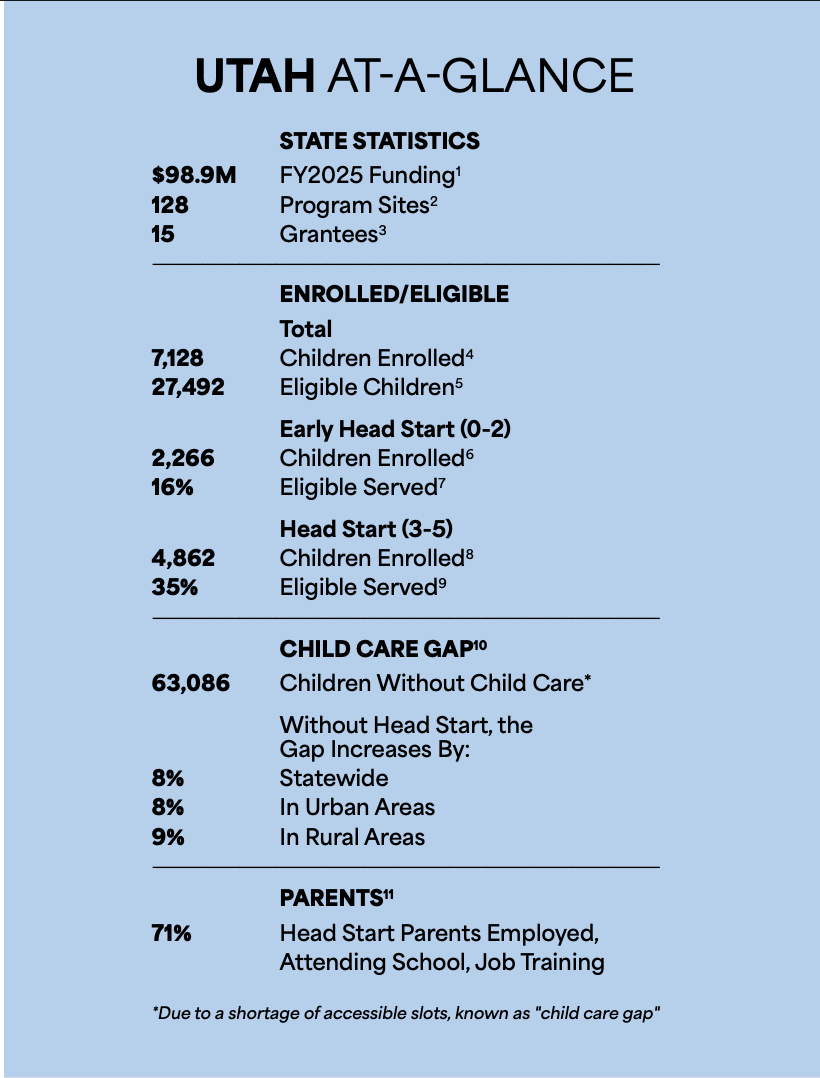
-
Source: https://www.ffyf.org/wp-content/uploads/2026/09/2026HS_UT.pdf
How the Federal Changes will Impact Families
On August 7, 2026, the U.S. Department of Health and Human Services (HHS) proposed replacing the current Head Start Program Performance Standards with a less prescriptive framework. The proposal would:
- Eliminate Head Start-specific staff-to-child ratios
- Remove the requirement for 1,020 annual hours for a portion of preschool enrollment, and
- Reduce certain detailed federal requirements related to developmental screening and assessment
These changes are important because Head Start standards provide a consistent quality floor for children and families. They help ensure teachers have the time and resources to support children's development and identify concerns early.
Classroom Ratios
The proposal would eliminate Head Start-specific staff-to-child ratios. NIEER's August 2026 analysis found that only 12 states, or 24%, meet Head Start's 1:4 ratio for children ages 1–2. For children around age 2½–3, the median state licensing standard allows one adult for eight children, twice the Head Start ratio.
Ratios are not just about classroom management. Early childhood educators are responsible for teaching, supervising, managing transitions, supporting behavior, building relationships, and communicating with families. Fewer children per educator create more opportunities to notice when a child may need additional support.
Staffing ratios and developmental screening work together. Screening provides a formal way to identify potential concerns, while appropriate classroom conditions give educators more opportunities to notice and respond to children's needs every day.
Program Hours
The proposed rule would also remove the current requirement that at least 45% of Head Start preschool center-based funded enrollment receive 1,020 annual hours of planned class operations.
For many families, Head Start serves two important purposes: it provides children with an early learning environment while giving parents reliable care that allows them to work or attend school.
Reducing program hours does not eliminate a family's need for child care. Families may have to find additional care, adjust their work schedules, or take on additional costs. HHS's own analysis recognizes that shorter Head Start schedules could have child care and employment-related consequences for families.
For families already struggling to afford care, additional costs or schedule changes can be difficult to absorb.
Developmental Screening and Early Identification
Developmental Screenings give families and educators an opportunity to identify children who may need additional support. Head Start currently requires developmental screening and establishes expectations around assessment, documentation, communication with parents, and referrals. The proposed rule would maintain the statutory screening requirement, but remove many of the detailed federal requirements for how screening and assessment are conducted.
The Ages and Stages Questionnaire (ASQ) is a parent-completed developmental screening tool that looks at communication, gross motor, fine motor, problem-solving, and personal-social development. It helps identify children who may need additional monitoring or evaluation, but it is not a diagnostic tool.
The CDC recommends developmental monitoring and screening because early identification can help connect children with appropriate services sooner. The CDC estimates that approximately 1 in 6 children ages 3–17 has a developmental disability.
For families, the takeaway is simple: the earlier a potential developmental concern is identified, the more time there is to connect a child with support.
How the Federal Changes will Impact Utah
These proposed changes are particularly relevant for Utah because the state has already invested in connecting information across early childhood program.
The Utah Early Childhood Integrated Data System (ECIDS) identifies ASQ Online accounts operated by the Utah Department of Health and Human Services, the Office of Child Care, Help Me Grow Utah, and the Utah Head Start Association. Utah Head Start programs use ASQ Online, and ASQ screening summary data are shared with ECIDS.
Utah's ECIDS Data Dictionary also includes measures for ASQ screening results, children screened through individual programs, crossover between programs, and Head Start enrollment. This infrastructure gives Utah an opportunity to better understand children's experiences across programs instead of treating each service as separate.
These integrated systems depend on consistent information. If federal changes lead to greater differences in screening practices, staffing, or program schedules, Utah could have a harder time comparing information across programs and understanding whether children are consistently receiving the supports they need.
What Utah Can Do
The proposed changes to Head Start are more than a change in federal regulations. They could affect:
- Children's classroom experiences.
- Educators' ability to provide individualized attention.
- How quickly developmental concerns are identified.
- Families' ability to maintain stable child care.
- Ability for families to afford care.
- Children's access to food.
For Utah, these changes also come at a time when the state has invested in systems that connect developmental screening and early childhood services. The proposed federal changes create an important question for Utah: Will the state rely on federal requirements and existing licensing minimums, or establish stronger expectations for publicly supported early childhood programs?
Utah can take steps to protect the quality and consistency of early childhood services by:
- Maintaining developmental screening and follow-up. Establish clear expectations for screening, parent communication, referrals, and follow-up, even if federal requirements change.
- Evaluating classroom ratios. If Head Start-specific standards are eliminated, Utah should consider whether current child care licensing requirements provide an adequate quality and safety floor for children.
- Understand the impact of program hours. Changes to Head Start schedules should be considered alongside their impact on child care costs, family employment, and continuity of care.
- Protect Utah's early childhood data infrastructure. Utah should continue to connect developmental screening, Head Start participation, child care, early intervention, and other early childhood services while protecting family privacy.
Research shows that staffing ratios, developmental screening, program hours, and comprehensive services all play an important role in creating supportive environments for young children. Removing common standards without establishing equivalent protections could lead to greater variation in the services children receive.
Utah has an opportunity to maintain a strong quality floor for children and families, one that supports early identification, meaningful teacher-child interactions, reliable access to care, and better information about whether children are receiving the support they need.
Take Action Today!
Public comments are open through October 6, 2026.
If you care about the future of Head Start and early childhood services in Utah, please take a few minutes to submit a public comment and reach out to your members of Congress.
Please share this information with families, providers, educators, and community members who want to make sure Utah's youngest children continue to have access to high-quality early childhood supports.
Additional Resources
Head Start NPRM Talking Points
Proposed Changes to Head Start Performance Standards
Learn more, check out these local Head Start Stories